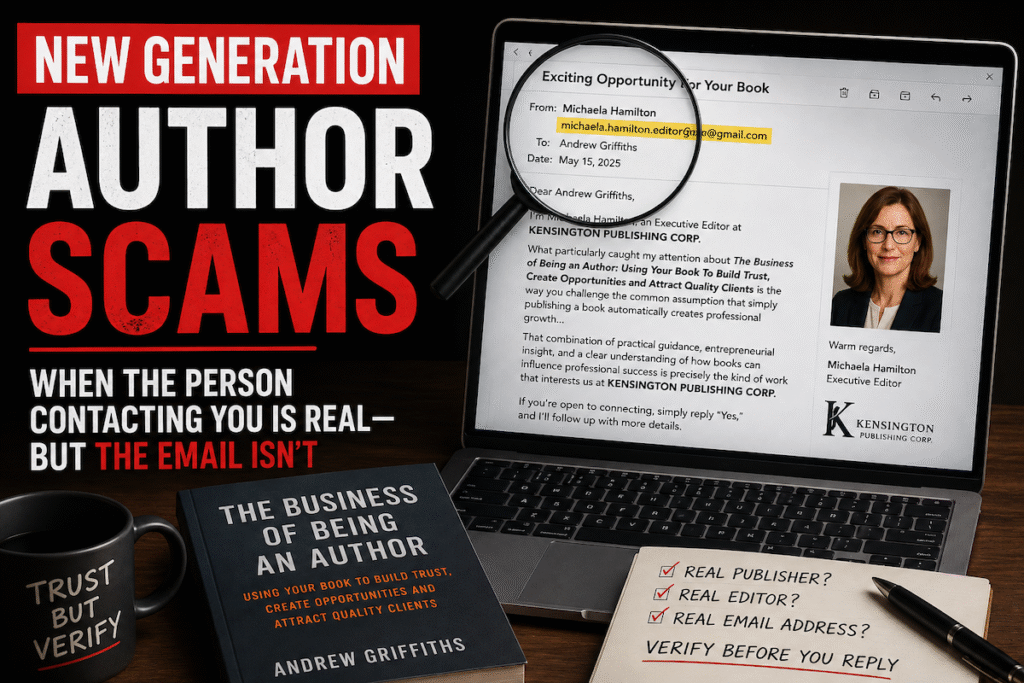
SCAMMERS ARE TARGETING AUTHORS NOW MORE THAN EVER. SO WHAT ARE THE NEW GENERATION AUTHOR SCAMS TO BE AWARE OF?
There’s a rather strange thing that starts to happen when you publish a book. People suddenly discover you.
A literary agent you’ve never heard of gets in touch to say they think your book has enormous international potential. A major publisher wants to talk about acquiring the rights. Someone from Hollywood thinks it would make a fabulous film. A book club wants to feature it. A podcast wants to interview you. And inevitably, there will be a marketing company somewhere in the world that is absolutely certain they can turn your book into a bestseller.
Now, I’ve been in the publishing world for a long time and I’ve worked with a lot of authors, and I can tell you that these approaches are becoming more common, more sophisticated and much harder to pick as scams.
And there’s a very simple reason why authors are such good targets. We desperately want people to discover our books.
We’ve spent months or years writing them. We’ve invested money in them and we’ve put a big chunk of ourselves into them. So when someone comes along and says, “We’ve found your book and we think it’s extraordinary,” of course we want to believe them. Unfortunately, that’s exactly what the scammers are counting on.
So here are ten of the most common scams I’m seeing targeting authors today, particularly first-time and self-published authors.
1. THE MAJOR PUBLISHER THAT HAS “DISCOVERED” YOUR BOOK
This is becoming incredibly common. Someone contacts you claiming to represent a major publisher and says they’ve discovered your book and believe it has significant commercial potential. They may even be using the name of a very well-known publishing house.
Everything sounds fantastic until you discover that before the deal can proceed you need to pay for an assessment, a rights certificate, some editing, legal documentation or a submission package.
That’s the moment to become very suspicious. Traditional publishers don’t generally offer authors significant publishing deals and then ask them to pay thousands of dollars to make the deal happen. If a major publisher really does contact you, fantastic. But find their official website yourself, contact the publisher directly and confirm that the person you’re dealing with actually works there.
2. THE LITERARY AGENT WHO THINKS YOU’RE THE NEXT BIG THING
This works in much the same way. An agent gets in touch, loves your book and wants to represent you. They have wonderful connections with major publishers, international rights buyers and possibly even film producers. Then you discover there’s a reading fee, representation fee, manuscript assessment or administration charge.
Legitimate literary agents generally make their money when you make money. They receive a commission when they successfully sell your work.
If an unsolicited agent wants money from you before they’ve achieved anything, I’d be asking a lot of questions. And one of the first would be very simple: what books have you actually sold and to whom?
3. THE HOLLYWOOD OR NETFLIX OFFER
This one is particularly clever because it goes straight for one of the great author fantasies.
Someone has discovered your book and thinks it would make an incredible movie or television series. Before long you’re talking about screen rights, casting, production budgets and numbers with lots of zeros attached.
There’s just one little hurdle. You need to pay for a screenplay, cinematic treatment, rights registration, coverage report or professional pitch package before they can take it any further.
Of course, genuine producers do approach authors and books really do get discovered in unexpected ways. But here’s the distinction I’d keep firmly in mind. If somebody genuinely wants to option the rights to your book, they pay you. You don’t pay them for the privilege of being interested in you.
4. THE PUBLISHER THAT ISN’T REALLY A PUBLISHER
You’ve been selected for publication. Congratulations! Then you’re presented with a range of publishing packages costing a fortune.
Now, I want to be careful here because there is absolutely nothing wrong with paying professionals to help you publish a book. I’ve worked with self-published authors for years and there are some excellent publishing service providers out there.
The problem is when a business presents itself as a selective traditional publisher when what it’s actually doing is selling you a publishing package, that’s unethical in every way.
Be very clear about what you’re buying. Is the publisher investing its money in your book? Are you sharing the investment? Or are you paying for everything? All can be legitimate models, but they are very different models and they need to be presented honestly. Anyone who isn’t up front about selling you something should be treated as suspicious.
5. THE “WE CAN RESCUE YOUR BOOK” SCAM
This one tends to target authors who already have a book in the market. Someone contacts you and explains why your book isn’t performing. Your cover isn’t right, the distribution is poor, your metadata needs fixing. Your previous publisher let you down. Some of what they’re saying might even be true, which is what makes the approach convincing.
Fortunately, they can rescue the book. Then come the new editing fees, new cover, new ISBNs, new distribution package, new marketing campaign and new publishing costs. I’ve heard stories of authors paying to republish the same book several times, each time convinced that the next company has the magic solution.
Sometimes a book genuinely does need to be repositioned or republished. But changing the logo on the copyright page isn’t a commercial strategy. Before spending another cent, understand exactly what’s wrong with the book, what they’re proposing to change and why those changes should produce a different result.
6. THE GUARANTEED BESTSELLER CAMPAIGN
Pay a company enough money and they’ll make your book an Amazon bestseller. And sometimes they actually will. But the reality is becoming an Amazon Bestseller is one of the easiest things to do. Seriously, it means very little and those in the publishing world know that.
For a few hours, coordinated purchases, free downloads or carefully selected categories can push a book to number one somewhere on Amazon. You get the screenshot and suddenly you’re a “number-one bestselling author.” I’ve worked with authors who become Amazon Bestsellers in obscure categories by selling 3 books.
I’m not particularly interested in manufactured bestseller status. I’d much rather have a book that sells consistently, builds authority, creates opportunities and gets talked about by real people. And I certainly wouldn’t be paying an “agency” thousands of dollars for something you can easily do yourself for nothing.
7. THE FAKE BOOK CLUB AND GUARANTEED REVIEWS
This one has really taken off. A book club has discovered your book and its hundreds of members would love to read and review it. You simply need to pay an administration fee, promotional charge, reader incentive or, wonderfully, sometimes even contribute towards refreshments for the book club.
What you’re really doing is buying reviews, often from people who haven’t read the book.
Apart from the obvious ethical problem, fake or incentivised reviews can breach retailer policies and potentially put your book or account at risk.
Give me two thoughtful reviews from people who’ve actually read the book over twenty generic five-star reviews from strangers any day.
8. THE MARKETING PACKAGE THAT MARKETS NOTHING
This is another perennial favourite. For several thousand dollars you’ll receive global media exposure, social media promotion, press releases, SEO, a book trailer and access to hundreds of thousands of readers.
A month later you’ve got a generic press release sitting on websites nobody visits, a few templated graphics, some social media posts nobody engaged with and a book trailer that looks like it was made during someone’s lunch break.
Technically, they’ve done what they promised. Commercially, absolutely nothing has happened.
This is where authors need to get much better at separating activity from outcomes. Sending a press release is activity. Getting meaningful media coverage is an outcome. Posting on social media is activity. Getting your book in front of the right readers is an outcome.
Always ask who they’re actually reaching and what a successful campaign will look like.
9. THE FAKE PODCAST OR MEDIA INVITATION
You receive a lovely invitation to appear on a podcast, radio program, magazine or author interview series. Increasingly these approaches are incredibly personalised because AI makes it easy to research you and your book and create a very convincing invitation.
Then, somewhere in the conversation, the fee appears.
Not every paid media opportunity is dodgy. Advertorials, sponsored interviews and legitimate promotional packages have been around forever. The issue is whether they’re being honest about what they’re selling.
One question normally clears things up pretty quickly: am I actually being invited as the guest, or am I the customer?
10. THE IMPERSONATION SCAM
This is the one I think we’re all going to have to become much more alert to.
Someone impersonates a genuine publisher, agent, podcast show host, television producer, bookstore, famous author or publishing platform. The logo is right and the person’s name is real. The email address looks almost right and the communication can be remarkably convincing.
Then they ask for money, banking information, account details, identification, manuscripts or login credentials.
AI is making this kind of scam much easier to execute and much harder to spot. Never assume someone is legitimate simply because they know a lot about you or your book. Most of that information is publicly available.
If you’re unsure, don’t click the link they’ve given you or call the number in their email. Find the organisation independently, go to its official website and contact them yourself.
THE 60-SECOND AUTHOR SCAM TEST
Before handing over money, rights or information, take 60 seconds and ask yourself:
1. Can I independently verify who this person is?
2. Why have they approached me specifically?
3. Are they promising unusually large results?
4. Does the opportunity suddenly require me to pay money?
5. Are they pressuring me to move quickly?
6. Can I independently verify authors they’ve helped?
7. Are they selling genuine outcomes or impressive-sounding activities?
8. Does their email address exactly match the organisation they claim to represent?
9. Who ends up owning my rights, files and intellectual property?
10. If I remove all the flattering language, does this opportunity still make commercial sense?
Authors aren’t targeted because they’re stupid. They’re targeted because they’re hopeful.
You’ve spent years creating something important to you. You want people to discover it. You want someone influential to recognise its potential. And after all the hard work that goes into writing and publishing a book, of course it’s exciting when someone comes along and tells you they see something special in it.
Scammers know that. And increasingly, they have the technology to research you, understand your book and make their approach look remarkably convincing.
So enjoy the genuine opportunities when they arrive. Just don’t let excitement replace judgement. Give yourself 60 seconds to check who you’re dealing with and whether the opportunity actually stacks up.
My fundamental rule is simple: If somebody says they’ve discovered the extraordinary value in your book, make sure their first objective isn’t extracting that value from you.