I’ve just spent a few days in Melbourne and Sydney and, as usual, I spent a considerable amount of time in bookshops. I always do. I’ve spent thousands of house in bookshops all around the world, and I do it for a very specific reason.
If You Want to Write a Successful Book, Spend More Time in Bookshops
I don’t necessarily go in with a list of books I want to buy, although I generally emerge carrying at least a few. I go because spending time in bookshops is one of the best forms of research an author can do.
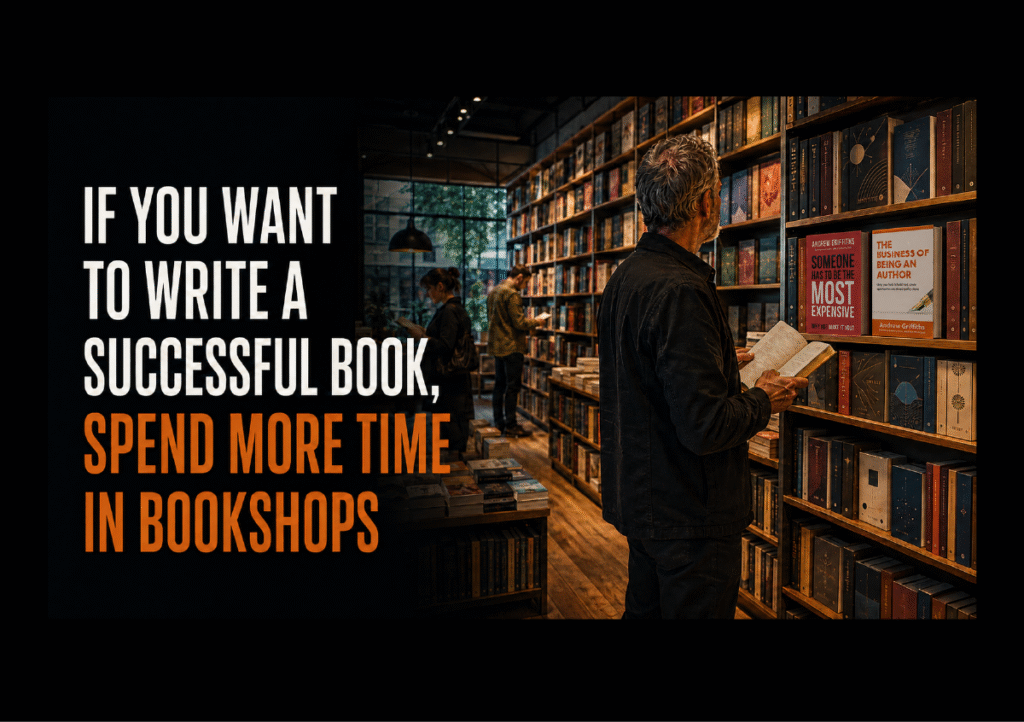
In fact, I’m a bit of a book stalker when I’m in a bookshop. I wander slowly from shelf to shelf, picking up books, studying their covers, reading their back-cover copy and flicking through their pages. I look at what other people are picking up, what makes them pause and what they put back on the shelf after a quick glance. All in the name of research, of course.
I’m also looking for trends. What subjects are publishers investing in? Which topics seem to be gaining momentum? How many new books are appearing on leadership, artificial intelligence, mental health, entrepreneurship, personal finance or longevity?
I’m looking at titles and subtitles. I’m studying cover designs, colour choices, formats and internal layouts. I’m interested in how chapters are structured, how much white space is used, whether the author has included stories, frameworks, diagrams, exercises or summaries and how the book feels when I hold it in my hands.
Yes, I spend time researching online as well
I spend a great deal of time researching books online as well, and I encourage the authors I work with to do exactly the same. Online research makes it possible to explore books from around the world, compare categories, read reviews, study rankings and see how readers are responding to particular topics and ideas.
This is vital research, but it is entirely different from spending time in a physical bookshop. Online, we tend to see books one at a time. Each book is presented as an isolated image on a screen, often carefully positioned to look as appealing as possible.
In a bookshop, the reality is very different. A book has to sit on a shelf beside dozens of other books competing for the same reader’s attention.
You can see which books jump off the shelf and which ones seem to disappear. You can pick them up, feel their weight, run your fingers over the cover and flick through the pages. You can see whether the internal design makes you want to keep reading or whether it feels overwhelming, dated or difficult to navigate.
You can also see the book in its natural habitat, surrounded by its competitors.
If you’re writing a business book, go and stand in the business section. Find the part of the shelf where you believe your book would belong and take a long, honest look at what is already there.
- How many books are addressing the same topic?
- What promises are they making?
- What appears to be missing?
- What are the trends appearing in cover design?
- What are the trends in titles?
- And, perhaps most importantly, why would a reader pick up your book instead of one of the twenty books sitting beside it?
One of the biggest mistakes first-time authors make is developing their book in isolation. They become understandably excited about their idea, but they don’t spend enough time looking at what has already been written or considering the marketplace their book will eventually enter.
They often tell me there is nothing else quite like their book. Sometimes that’s true. But sometimes a trip to a good bookshop reveals an entire shelf of books covering remarkably similar territory.
This doesn’t mean you shouldn’t write your book. It means you need to become much clearer about what will make it different, relevant and valuable. What do you know that others don’t? What have you experienced that gives you a distinctive perspective? What are you prepared to say that other authors have avoided saying?
The objective isn’t to imitate what other authors are doing. It is to become better informed about the world you are hoping to enter.
Become a book stalker for an afternoon
Publishing trends change over time. cover designs change, reader expectations change and the way we consume information changes. If the only books you are using as references were published ten or fifteen years ago, there is a very real chance your book will feel dated before it is even released. To me I tend to learn the most from the books published in the last 6-12 months.
So, if you’re thinking about writing your first book, or you’ve already started, spend a few hours in a large bookshop. Take your time, pick up lots of books, feel them, read the covers, flick through the pages, study the shelves. Watch what other people are picking up. Become a book stalker for an afternoon. Sit and watch, see what customers are buying, picking up and putting back down. And make sure you don’t just look at your section in the bookshop, look at all sections, learn about what’s being created, what’s selling and what’s not.
And buy a few books while you’re there. Bookshops certainly need our support
What you will learn about books from picking them up, feeling them, flicking through their pages and seeing them surrounded by other books will give you an extraordinary amount of vital information. You will begin to understand not only what is being published, but what makes a book feel credible, contemporary, appealing and worth buying.
In fact, the more time you spend doing this, the harder it becomes to imagine writing a book without it.
If you are serious about becoming an author, bookshops shouldn’t simply be places you visit after your book has been published to see if yours is on the shelf. They should be part of how you learn to write one worth publishing.