I recently ran a Masterclass called “How to Write a Commercial Book That Matters in the Age of AI”. And I think this is becoming one of the most important conversations we can have about writing books right now.
We are living in a world that is rapidly being flooded with mediocre, AI-generated content. It’s easy and fast to produce, much easier than actually taking the time to write a book. Increasingly, AI creates same/same. That’s how it works, drawing off of the collective. This means much of what it creates reads kind of right, but it lacks soul, it’s beige and it’s the same as what other people using AI are now publishing.
To me, this translates into a big opportunity for genuinely human authors. In fact I don’t think the opportunity has ever been greater.
The answer isn’t to compete with AI by writing faster
In fact I think it’s time to go in the opposite direction. To write books with more depth, more original thinking, stronger opinions, better stories and considerably more of the lived experience and hard earned wisdom that only you can bring.
The real value of your book isn’t simply the information it contains. It’s “you”, your journey, your mistakes, your successes, your observations, stories and perspective on the world. It’s what you have learned from actually doing the work, often over many years, that gives your book substance and makes it worth reading.
During this one hour deep dive, I shared a practical roadmap for writing a meaningful, significant and deeply human book that can build trust, create opportunities and attract quality clients.
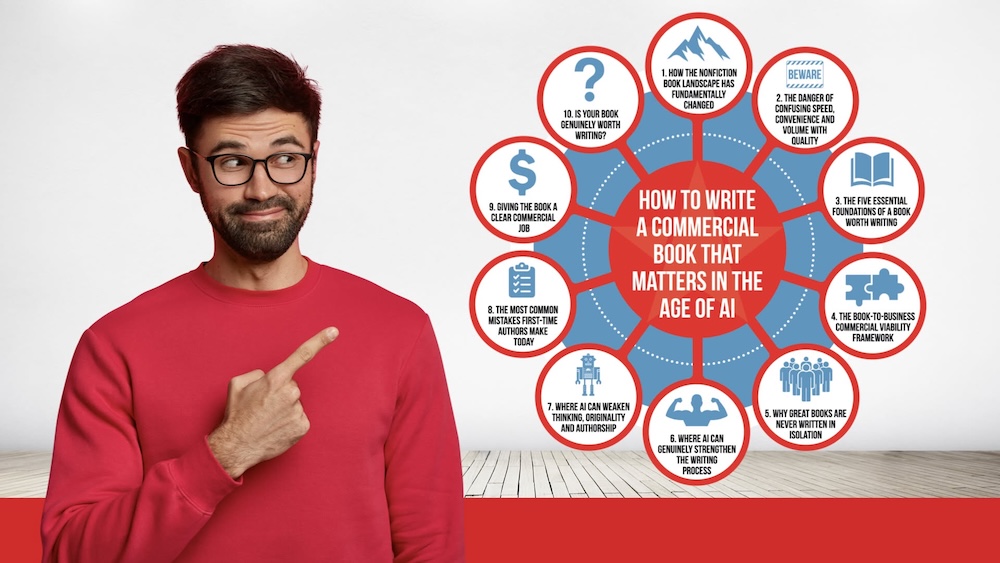
This one hour, deep dive masterclass covered 10 key areas – including:
1. How the nonfiction book landscape has fundamentally changed
2. The danger of confusing speed, convenience and volume with quality
3. The five essential foundations of a book worth writing
4. The Book-to-Business Commercial Viability Framework
5. Why great books are never written in isolation
6. Where AI can genuinely strengthen the writing process
7. Where AI can weaken thinking, originality and authorship
8. The most common mistakes first-time authors make today
9. Giving the book a clear commercial job
10. Is your book genuinely worth writing?
We also explored the commercial side of the equation, which included my ten point Commercial Viability Framework for determining whether a book idea has genuine potential before spending months, or years, writing it.
That means asking some pretty important questions. Does your book solve an expensive enough problem? Is there a clearly defined audience who genuinely cares about that problem? Do you have original ideas and signature intellectual property? Can you build products, services and opportunities around the book? Is the idea bookable? And does it have the potential to create a community around it?
AI is changing the world of authorship at an extraordinary pace.
But I don’t believe that makes human authors less valuable. I think it makes the very best human authors more valuable than ever.
The challenge is to resist the temptation to use AI simply to make everything faster and easier, and instead use this extraordinary technology to help us think better, research deeper and ultimately create books with considerably more substance.
Because in the age of AI, being deeply human might just become your greatest competitive advantage as an author.
If you would to discover how to write a commercial book that matters in the age of AI you can watch the recording by clicking here .