Authors of substance write books of substance.
There is something I want to say to every aspiring author, every first-time author and every experienced author – the world has changed, and readers have changed with it.
The days of sitting in a room, or on a desert island, having a thought and deciding, “Well, that’s my book,” are largely behind us. That might have worked once, when information was scarce, competition was lighter and readers were easier to impress. Not anymore.
Today, readers are more sophisticated. Business is more complex. Information is everywhere. Everyone has a theory, everyone has a framework, everyone has a five-step process and now, thanks to AI, everyone can produce a manuscript faster than they can develop a meaningful point of view. That is not necessarily a good thing.
Passion Is Not Enough Anymore
If you want your book to build your credibility, strengthen your brand, attract better opportunities and genuinely make a difference, you cannot afford to write it in isolation. Not if you want it to matter. Not if you want it to stand out. Not if you want it to do more than take up space on Amazon with all the other beige books written by people who had an idea but never did the real work to develop it.
Writing a world-class nonfiction book today demands much more than passion for your subject. Passion is lovely, but passion on its own is not enough. You need to become immersed in your field. You need to know who else is leading the conversation, what they are saying, what they are missing and where your thinking fits. More importantly, you need to understand what makes your ideas different and why someone should choose your book instead of the dozens, or hundreds, of others already available.
That level of understanding goes far beyond a few Google searches or asking ChatGPT to summarise your topic. It means becoming a genuine student of your subject. It means reading widely, listening deeply, seeking out smarter people, challenging your own assumptions and being prepared to discover that your first idea may not be nearly as strong as you thought it was.
Can You Prove It?
One of the most important questions every author should ask is this: can I prove it? Can you prove what you are saying? Do you have the experience behind your ideas? Do you have stories, case studies, examples and results that show your thinking actually works? Have you seen the transformation yourself, or are you simply repeating what someone else has already said in slightly different language?
That is a confronting question, but it is the right one.
Readers are no longer looking for recycled information. They are looking for insight. They want to learn from people who have done the work, wrestled with the issues, solved the problems, made the mistakes, paid attention and earned the right to write about them. A book without proof is just a long opinion, and the world does not need more long opinions.
Better Books Are Made in the Tension
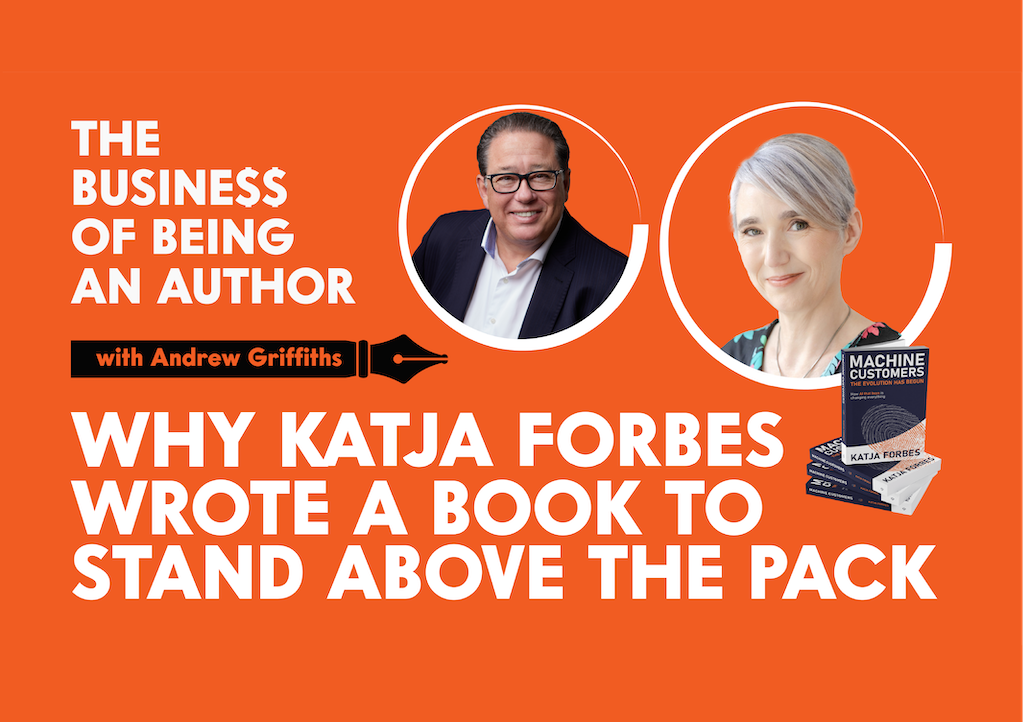
I recently worked with the extraordinary Katja Forbes as she developed her remarkable book, Machine Customers. One of the smartest things Katja did throughout the process was deliberately seek out the world’s leading thinkers in artificial intelligence and machine-to-machine commerce. She shared her ideas, she invited criticism, she asked difficult questions and she stress-tested her thinking before the manuscript was finished. Nothing was done in isolation.
That takes courage.
It is much easier to protect your ideas than it is to expose them to people who might challenge them. It is much easier to stay in your own little bubble, surrounded by people who nod politely and tell you your book sounds amazing. But that is not where better books are made.
Better books are made in the tension. They are made when your thinking is challenged, sharpened, tested and strengthened. Katja will be the first to tell you that her book is dramatically better because of that process. It has greater depth, greater credibility and greater confidence because it was refined long before it was published. That is the standard today’s authors should be aiming for.
Familiar Ideas Rarely Make Memorable Books
There is another trap I see all the time. I pick up a business book, turn to the first page and find a quote from Simon Sinek telling me to “Start With Why.”
Now let me be clear. Simon Sinek is brilliant. His work has had an enormous impact on millions of people. The problem is not Simon Sinek. The problem is that we have all seen it before, so many times, to the point where it in a brand new book, it immediately feels old and the author feels out of touch with the reader.
When I see another author leading with the same quote that has appeared in thousands of keynote presentations, leadership workshops and business books over the past twenty years, I immediately wonder whether they have really thought about what today’s reader needs. Familiar ideas are comfortable, but they rarely make a book memorable.
Your job as an author is not simply to repeat what has already been said. Your job is to contribute something worthwhile to the conversation. You do not have to be shocking for the sake of it. You do not have to invent an entirely new universe. But you do need to bring something fresh, useful, honest or deeper than what is already out there.
Depth Is Often the Difference
Sometimes originality is not about having a completely new idea. Sometimes it is about bringing extraordinary depth, commercial relevance, better language, stronger stories, sharper proof or more humanity to an existing idea. The marketplace does not always need another brand-new concept. But it does need better thinking. It needs people who can make sense of complexity, challenge lazy assumptions and help readers see their world differently.
That is why Brené Brown’s work has had such extraordinary impact. Her writing is grounded in years of rigorous research, but it is her willingness to combine that research with deeply personal stories that makes her books resonate. Readers trust her because they see both the evidence and the humanity behind her ideas. There is nothing lightweight about the thinking, and there is nothing cold or academic about the delivery.
That is the lesson for every author. Your value does not come from simply having an opinion. Everyone has one of those. Your value comes from developing that opinion, testing it, supporting it with evidence, enriching it with experience and presenting it in a way that only you can.
That is where authority is built. Not in the claim, but in the substance behind the claim.
Raise Your Own Standard
Ultimately, what I am encouraging authors to do is raise their own standard. Push yourself harder. Ask better questions. Read better books. Talk to smarter people. Find the gaps in your thinking before your readers do. Surround yourself with people who will challenge you rather than simply applaud you. Become a genuine expert, not someone who has simply gathered a pile of information and arranged it into chapters.
AI is making it remarkably easy for people to produce books. Unfortunately, it is also making it remarkably easy to produce very ordinary books. That is the great danger of this moment. Not that AI will replace authors, but that it will tempt too many authors to skip the deep thinking, the hard-earned insight and the lived experience that make a book worth reading.
Readers are smarter than we often give them credit for. They can tell the difference between a book that has been built on genuine experience, proof and substance and one that feels like a collection of borrowed ideas dressed up as thought leadership. And they are getting better at spotting the difference.
If your ambition is to write a book that creates opportunities, builds authority and stands the test of time, then do not settle for being another beige author writing another beige book. Do the work. Get challenged. Build the evidence. Earn the authority. Write something that could only have come from you.
Because great books are never written in isolation. They are shaped by experience, sharpened by challenge, strengthened by evidence and brought to life by an author who has done enough work to have something genuinely worth saying.
That is what the world needs more of. Authors of substance writing books of substance.